In this article
- What real Ethiopian opal looks like
- The imitations, one at a time
- Opalite: glow, but no fire
- Synthetic opal: too neat
- Smoked and dyed Ethiopian opal
- Doublets and triplets
- The water test, and why to go carefully
- Other checks at home
- Ethiopian sold as Australian
- What only a lab can tell you
- Buying Ethiopian opal safely in Pakistan
- Buying from Authentic Gems
- خلاصہ

Written by Sameer
Reviewed on
In brief: natural Ethiopian opal shows play-of-colour in patches that shift and change as you turn the stone. Its body is usually white, cream, honey or crystal-clear, and it feels very light for its size. Opalite glass glows with a soft blue-orange haze but has no real patches of colour. Synthetic opal shows its colour in tight, regular columns or a "lizard skin" pattern. Smoked and dyed stones are natural opal with an artificially darkened body, and they should be declared.
Most of the opal now sold in Pakistan comes from the Welo (Wollo) region of Ethiopia. It is lovely, far cheaper than Australian opal, and it behaves differently: it is usually hydrophane, meaning it can soak up water. That one property explains several of the tests below, and one important warning. For opal in general, including Australian stones and doublets, see wearing opal and October's opal and tourmaline.
What real Ethiopian opal looks like
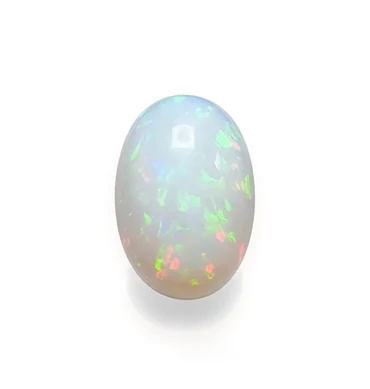
Natural opal is hardened silica gel that contains water, at about 5.5 to 6.5 on the Mohs scale. Its play-of-colour comes from tiny silica spheres stacked in a regular arrangement that splits light into colours. In Ethiopian opal you will usually see:
- A light body colour: white, cream, pale yellow, honey or transparent "crystal".
- Patches of colour that appear and vanish as you tilt the stone, often in a honeycomb or "digit" pattern of small cells in the best Welo material.
- Colour that sits inside the stone, with depth, not painted on top.
- Very little weight. Opal is one of the lightest gems, with a specific gravity of about 2.0 to 2.2.
- Small natural flaws: areas of common opal with no colour, faint brown matrix spots, or a slightly uneven body.
The Ethiopian stones in our opal collection, such as the 1.50-carat Ethiopian opal and the 1.90-carat Ethiopian opal, show these features clearly in their photos and videos.
The imitations, one at a time
| Material | How it looks | Main clue |
|---|---|---|
| Opalite | Milky glass with a blue glow, orange against dark | No patches of colour, only a haze |
| Synthetic opal | Very bright, even play-of-colour | Columnar or "lizard skin" pattern, too regular |
| Resin imitation | Plastic with colourful flakes | Very light, warm and soft; flakes look flat |
| Smoked opal | Natural opal with a dark brown or black body | Colour only near the surface; can rub or chip off |
| Dyed opal | Natural opal dyed black, blue or other colours | Dye in cracks and pits; uneven body |
| Doublet or triplet | Thin opal glued to a backing, sometimes with a clear top | Join line visible from the side |
Opalite: glow, but no fire
Opalite is a man-made glass sold as "sea opal", "moon opal" and similar names. It looks bluish-white against a light background and turns orange-amber against a dark one. That is opalescence, an even glow, not play-of-colour. Turn it under a single light: real opal throws separate flashes of green, blue, orange or red that move around, while opalite shows no distinct flashes at all. It often has small round bubbles you can see with a loupe, and it is heavier than real opal.
Synthetic opal: too neat
Lab-made opal shares natural opal's basic structure and can be very convincing. The pattern gives it away. Look at the colour from the side with a loupe: synthetic opal often shows colour in vertical columns, and from the top a scaly, mosaic pattern people call "lizard skin" or "chicken wire". In natural opal the colour patches are irregular, with soft edges and different sizes.
Some synthetic opal is also stabilised with resin and is less porous than natural Welo opal. A lab can confirm a synthetic easily. If a bright, flawless opal is offered for very little, assume it is synthetic until shown otherwise.
Smoked and dyed Ethiopian opal
Because Welo opal soaks up liquid, it can be darkened. "Smoked" opal is wrapped in paper and heated so the smoke gets into the surface, and the result looks like expensive black opal. Other stones are treated with sugar and acid, or simply dyed, to give a black or coloured body.
These are natural opals that have been treated, and they are acceptable only when disclosed and priced as treated. Signs to look for:
- A dark body that is suspiciously even, with no lighter natural areas.
- Colour gathered in pits, cracks and the drill holes of beads.
- A lighter interior showing at a chip or a worn edge.
- A faint smoky smell, or a dull, waxy surface, on smoked stones.
- Darkening that comes off on a cotton bud with a little acetone, on a stone you own.
Authentic Gems states known treatments on every listing.
Doublets and triplets
A thin slice of opal glued onto dark stone, glass or plastic is a doublet; put a clear quartz or glass dome on top and it becomes a triplet. They are common with Australian opal and less so with Ethiopian, but they do turn up. Look at the stone side-on with a loupe. A straight, flat join running around the girdle, with a different material below it, means the stone is assembled. In a closed-back ring the join is hidden, which is one reason to buy opal loose or in an open-back setting first.
The water test, and why to go carefully
Ethiopian opal is usually hydrophane. Put a drop of water on the surface and after a few minutes that patch may go clearer, or the play-of-colour may fade. As the stone dries over hours or a day or two, it goes back to normal. That is a fair clue to natural Welo opal, since glass and most synthetics do not react.
But be careful with it:
- Never soak the whole stone, and never in oily, dirty or coloured liquid. Hydrophane opal can take up the colour permanently.
- Do not test a stone that is not yours without the seller's agreement.
- Do not test a dyed or smoked stone, because water and solvents can make the colour run.
- Let it dry naturally, away from heat. Sudden heat can crack opal.
Many sellers would rather you skipped the water test altogether and judged by pattern, weight and loupe. That is a fair request.
Other checks at home
- Turn it under one light. A phone torch or a window will do. Look for separate patches of colour that move, not an even glow.
- Study the pattern with a loupe. Irregular patches suggest natural; columns or a tidy mosaic suggest synthetic.
- Check the sides. A join line means a doublet or triplet.
- Feel the weight. Opal is light. Glass of the same size feels heavier; resin feels lighter and warmer.
- Look into pits and cracks. Dark colour collected there points to dye or smoking.
Our wider guide to real or fake gemstones covers the general methods.
Ethiopian sold as Australian
The reverse problem happens too. Australian opal costs a good deal more, so a bright Welo stone, particularly a smoked one, is sometimes sold as Australian. Australian opal is generally non-hydrophane and denser in body, and solid black Australian opal has a naturally dark body that runs right through it. If a seller insists a stone is Australian, ask how they know, and treat a very low price as a red flag. For what genuine Australian stones offer, see the Australian opal buying guide. Neither origin is "better" for everyone: Welo opal often gives brighter colour for the money, while Australian opal is more stable around water.
What only a lab can tell you
- Whether an opal is synthetic when the pattern is not obvious.
- Whether it has been impregnated with resin or polymer.
- Whether a dark body colour is natural or comes from smoking or dye.
- Whether a stone is Ethiopian, Australian or from somewhere else, where that affects price.
A lab report is worth having for a large or expensive opal, or one bought for astrological use, where many families want a natural, untreated stone. See lab-certified opal and how to read a gemstone lab certificate.
Buying Ethiopian opal safely in Pakistan
- Ask three questions in writing: is it natural, is it Ethiopian, and is it treated (smoked, dyed or impregnated)?
- Ask for a video of the stone turning under a single light. You cannot judge play-of-colour from one photo.
- Get the weight in carats. If the seller quotes ratti, the gem ratti is 0.91 carat; convert with the carat to ratti converter.
- Prefer a loose stone or an open-back setting, so nothing is hidden.
- Check that the price makes sense against Ethiopian opal prices in Pakistan.
- Buy from a seller who accepts returns, so you have time to get the stone checked.
Looking after it once it is yours
Keep Ethiopian opal away from oils, lotions, perfume and soapy water, all of which it can absorb. Wipe it with a dry or barely damp soft cloth. Avoid sudden temperature changes and ultrasonic cleaners, and store it on its own so harder stones cannot scratch it.
Buying from Authentic Gems
Every opal we sell is natural, photographed on its own and listed with its weight, origin where known and any treatment. If you want an independent lab report, ask before ordering. We ship from Karachi with Cash on Delivery: Karachi orders usually arrive in 1 to 2 working days, Lahore, Islamabad and other major cities in 2 to 4, smaller towns in up to about 7. Open the parcel and look at the play-of-colour before paying the rider, and return the stone within 7 days if it is not what you expected. For a video of any opal, message us on WhatsApp.
Shop the stones: ethiopian opal.
References