In this article

Written by Sameer
Reviewed on
Ethiopian opal turned the opal market upside down. Before the big finds in Ethiopia's Welo region, a bright opal with strong colour flashes was out of reach for most buyers in Pakistan. Ethiopian material made bright, transparent to milky opal with lively play-of-colour easy to get hold of, and much of the opal on offer here now comes from there.
That does not mean every Ethiopian opal is cheap. Prices still swing a long way between stones of the same weight, and once you know where to look, most of the reasons are visible. This guide explains them, shows our own price range in the table below where available, and sets out how to compare per-carat and per-ratti quotes. To check authenticity, read our Ethiopian opal real or fake guide.
Our Ethiopian opal prices
The table is built from our own Ethiopian opal listings and refreshed every month. It shows the lowest, typical and highest price per stone, and per carat and per ratti.
| Weight | Weights | Stones | Per carat | Per ratti |
|---|---|---|---|---|
| Under 3 carat | 1.5 – 2.7 ct | 4 | Rs 3,100 – Rs 5,000 | Rs 2,800 – Rs 4,600 |
| 3 – 6 carat | 3.0 – 5.4 ct | 12 | Rs 1,700 – Rs 8,300 | Rs 1,550 – Rs 7,600 |
| 6 – 10 carat | 6.1 – 8.7 ct | 5 | Rs 1,600 – Rs 2,500 | Rs 1,450 – Rs 2,300 |
The per-ratti column uses the standard gemstone ratti of 0.91 carat. The prices are for loose, solid opal; doublets, triplets and set rings are different products. For other opal types and other stones, see our monthly gemstone price guide and the general opal price guide.
What sets Ethiopian opal apart
Most Ethiopian gem opal is hydrophane, meaning it is slightly porous and can soak up water. When wet, a hydrophane opal may go more transparent and its play-of-colour may fade for a time; as it dries over hours or days it usually returns to normal. This is a natural property, not a fault, but it affects how you buy, clean and price the stone. A stone that has been properly dried and has stayed stable since cutting is worth more than freshly cut material that could still craze, that is, develop fine surface cracks.
Next to Australian opal, Ethiopian stones are usually brighter for the money, more often light or crystal in body, and a little softer in feel because of that porous structure. Our Australian opal price guide covers the other side of the comparison.
What decides the price
1. How bright the play-of-colour is
Every dealer looks at this first. Hold the stone under a single light, ideally daylight from a window, and tilt it. A top stone flashes strongly from nearly every angle; a weaker one shows colour only at certain angles, or only faintly. Brightness beats size: a small, very bright opal can be worth more than a big, sleepy one.
2. Which colours appear
Blue and green flashes are the most common. Stones that also show strong orange and red across the whole face are scarcer and cost more. A full spectrum moving together is what people in the bazaar usually mean by a "fire" opal, although strictly that term belongs to a different, orange-bodied opal.
3. Pattern
How the colour is arranged affects value too:
- Pinfire: lots of small points of colour. Common and attractive.
- Broad flash: big patches of colour that light up as the stone turns.
- Honeycomb or cell pattern: colour arranged in small cells, closely linked with Ethiopian opal and sought after by collectors.
- Harlequin or mosaic: distinct, angular patches of colour. Rare, and priced well above ordinary patterns.
4. Body tone and transparency
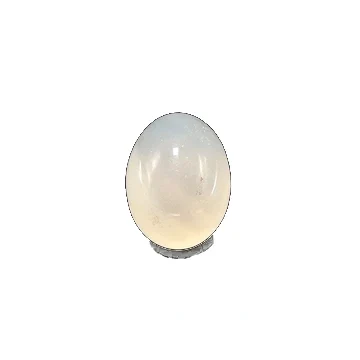
Ethiopian opal runs from white (milky) through crystal (transparent) to darker browns. Crystal stones with bright colour are popular because the flashes seem to float inside. Very milky stones can look flat. Natural dark-bodied Ethiopian opal exists but is less common, and much of the "black Ethiopian opal" on the market has been smoked or dyed, which brings us to treatment.
5. Treatment
Because hydrophane opal absorbs liquids, it is easy to treat:
- Smoking: heating the stone in smoke so carbon darkens the outer layers, giving a black body that makes the colour pop.
- Dyeing: soaking in dye, or in sugar-and-acid solutions, to darken the body.
Treated stones should cost far less than natural ones that look similar, and the treatment must be disclosed. A dark Ethiopian opal at a low price is often treated. We state treatments wherever we know them.
6. Clarity and stability
Cracks, crazing, sandy inclusions or patches of common (colourless) opal all reduce value. Look across the surface under a light for fine lines. A stone that has stayed stable for a while after cutting carries less risk.
7. Cut, shape and size
Most Ethiopian opal is cut as a cabochon, with a dome that shows colour from every side; faceted Ethiopian opal also exists, mostly in crystal material. A symmetrical shape and a good dome add value, while a thin, flat stone or a lopsided outline takes it away. Size raises the price, but less steeply than brightness does. For a ring, many buyers choose stones of a few carats, such as our 1.50 carat Ethiopian opal or the 1.90 carat Ethiopian opal.
8. Solid or assembled
Doublets (a thin slice of opal on a backing) and triplets (with a clear cap on top as well) are made from Ethiopian material too. They are fine when sold as such, but should cost a fraction of a solid opal with the same face size. Look at the stone from the side for a straight join line.
Per-ratti and per-carat pricing
In Pakistan opal is often quoted per ratti, especially when someone is buying on an astrologer's advice. The total is the weight in ratti times the rate. Two scales are in use:
- Standard gemstone ratti: 0.91 carat (about 0.182 g). This is the one we use.
- Jeweller's sunari ratti: about 0.61 carat (0.1215 g).
A 1.82 carat opal is 2 standard ratti but about 3 sunari ratti, so a "per ratti" quote means little until you know which ratti it is. Ask for the weight in carats, convert with our carat to ratti converter, and work out the price per carat for every quote.
One extra point for hydrophane opal: a stone that has just been washed or soaked can weigh very slightly more than when dry. The difference is small, but stones should be weighed dry.
Comparing quotes
- Ask for a video, not just a photo. Play-of-colour only shows when the stone moves, and a still photo with flash can make any opal look bright.
- Get solid, natural and untreated confirmed in writing. Otherwise you are comparing different products.
- Compare similar brightness and pattern. A bright honeycomb stone and a faint pinfire stone are not alternatives at the same price.
- Compare similar sizes, and convert everything to price per carat.
- Weigh up the terms. Cash on Delivery with inspection before payment, plus a return window, is worth a lot for a stone you cannot fully judge on a screen.
Browsing by budget
Our shop's price filters group every stone into four bands. Check the table above to see where our Ethiopian opal sits, then use the filters:
- under 5,000 rupees: smaller stones and gentler play-of-colour. Choose for even colour across the face rather than size.
- 5,000 to 20,000 rupees: ring-size stones with clear, lively flashes from several angles.
- 20,000 to 50,000 rupees: bright stones with strong colour across the face, better patterns and good size.
- over 50,000 rupees: exceptional brightness, rare patterns or large clean stones. At this level, get a lab report.
The filters cover every category, so pick opal from the list, or go straight to our opal collection, where each stone's name gives its origin when known.
Reading a listing photo
Since opal is priced on what its play-of-colour does, photos matter more than with most stones. A few habits help when comparing listings online:
- Check the background. Opal shot on black looks brighter than the same stone on white. Compare stones on similar backgrounds, or ask for both.
- Look for more than one angle. A single angle can catch the one bright flash a stone has. Several angles, or a short video, show how much of the face really lights up.
- Ask about the lighting. Strong spotlights make opal flash; cloudy daylight is a fairer test of how it will look on your hand.
Every opal we sell is photographed on its own, and we are happy to send extra angles or a video before you order.
Protecting the value
Opal is about 5.5 to 6.5 on the Mohs scale, softer than most ring stones. To look after what you paid for:
- Do not soak an Ethiopian opal, and keep it away from oils, perfume and creams, which a hydrophane stone can absorb and which can stain it.
- Clean it with a soft, slightly damp cloth only. No ultrasonic or steam cleaners.
- Avoid sudden heat and long hours in strong sun, including a car parked in a Karachi afternoon.
- In a ring, a bezel setting protects the edges; pendants and earrings face less wear.
Our how to wear opal guide covers settings in detail.
Opal and tradition
Many buyers here choose opal on an astrologer's advice, as a stone linked with Venus (Shukra) and often suggested in place of diamond. That is a belief, not a promised result. Our opal benefits article covers it, and opal is also a modern October birthstone, as shown on our October birthstone page.
Buying Ethiopian opal from Authentic Gems
Every opal is listed on its own with its own photo, weight and price, and we state known treatments. If you want an independent lab report, ask before ordering; see our lab-certified opal page. We ship from Karachi: orders in Karachi usually arrive in 1 to 2 working days, Lahore, Islamabad and other major cities in 2 to 4. Pay by Cash on Delivery, open the parcel and tilt the stone in daylight before paying the rider, and return it within 7 days if it is not right. For a short video of any stone, message us on WhatsApp.
Shop the stones: ethiopian opal.
The beliefs described here are traditions, shared for interest. They are not guaranteed outcomes, religious rulings or medical advice.
References