In this article

Written by Sameer
Reviewed on
Tiger eye, which most people here call chashm-e-babri, is one of the easiest stones to fall for and one of the easiest to pick badly. Nearly every piece has some shine to it, so even a weak stone can look fine in a quick photo. What separates a stone you will enjoy for years from a dull one comes down to a few things, and you can learn to see them in about a minute.
We go through them below in the order we check them ourselves: the band of light, colour, condition, cut, size, origin and treatment. After that come the questions worth asking a seller and how to choose when you can only see the stone on a screen.
What tiger eye actually is
Tiger eye is quartz that has taken the place of a fibrous mineral while keeping its parallel fibres. Light bouncing off those fibres creates chatoyancy: a bright band that runs across the stone and slides about as you turn it. The yellow-brown to golden colour comes from iron. It is about 7 on the Mohs scale, which makes it a good stone for a ring you wear daily.
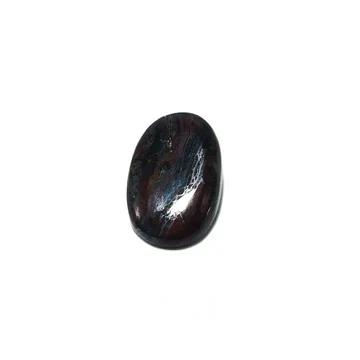
Two close relatives get mixed up with it. Tiger iron, which we list as iron tiger eye, is a banded rock combining tiger eye with red jasper and grey hematite; our tiger iron guide and the iron tiger eye category cover it. Cat's eye, or lehsunia, is chrysoberyl, a different and more expensive mineral with a single sharp line of light, explained in our lehsunia grading guide.
1. The band of light
This is what you are buying the stone for, so judge it first.
- Brightness. The best stones have a bright, silky, almost metallic band, set against darker areas on either side.
- Movement. Turn it slowly under a single light. The band should roll smoothly over the surface, and in a good stone the light and dark areas swap sides as you rotate it. That "flip" is what makes tiger eye feel alive.
- Sharpness. A crisp band looks better than a broad, hazy one. Some stones show more than one band, which is fine so long as each is bright.
If the shine looks the same from every angle, the chatoyancy is weak, and the stone will look flat once it is in a ring.
2. Colour
There are three main colours:
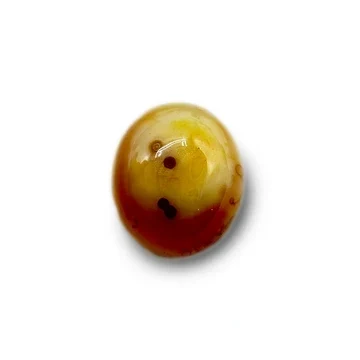
- Golden is the classic, anywhere from honey yellow to deep golden brown. An even, warm gold with a strong band is what most people choose.
- Red tiger eye, sometimes called ox eye, is normally golden stone that has been gently heated, which turns the iron reddish. It is an old, stable treatment and should be stated.
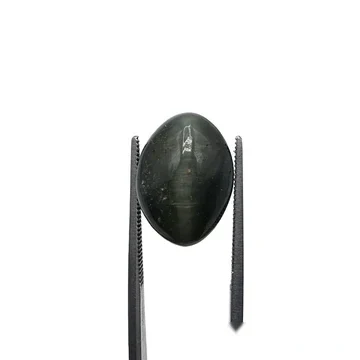
- Blue tiger eye, also sold as hawk's eye or falcon's eye, is the same structure before the original mineral fully altered. Its blue-grey to dark blue colour is natural.
You want colour that stays even across the face, with no muddy or grey patches. Bright, unusual colours such as pink, purple or vivid green are dyed. That is not a scandal, but those stones should be sold and priced as dyed.
3. Condition
Tiger eye is opaque to slightly translucent, so here clarity really means soundness. Check for:
- Cracks running across the fibres. They weaken the stone and catch the light in an ugly way.
- Pits or soft spots on the polished surface where fibres have pulled out.
- Chips around the edge of the cabochon, which matter more on a ring stone.
Thin dark streaks running along the fibres are natural and nothing to worry about. What you want is a smooth, glassy polish over the whole dome.
4. Cut
Tiger eye is nearly always cut as a cabochon, a smooth dome, and the cut can make or ruin it. The cutter has to set the base parallel to the fibres so the band runs straight across the centre. Get the orientation wrong and the band ends up off to one side, broken, or barely there.
Look at the height of the dome too. A moderately high dome gathers the band into a sharper line, while a very flat stone shows a wide, weak one. Ovals and rounds are the usual ring shapes. Flat polished slabs are used for engraving and inlay, where chatoyancy matters less.
5. Size
Tiger eye is plentiful, so bigger stones don't carry the steep premium that rare gems do. You can choose size by taste and by the ring you have in mind. For men's rings, roughly 8 to 15 carats is common. For a woman's ring or a pendant, a smaller stone often looks better balanced.
In Pakistan stones are weighed in carats or ratti. The standard gemstone ratti is 0.91 carat; the jeweller's sunari ratti is smaller, about 0.61 carat, so always ask which one is meant. An 11.00 carat stone, for instance, comes to about 12.1 standard ratti. Our carat to ratti converter does the sums for you.
6. Origin
Most tiger eye traded worldwide comes from southern Africa, with more from Asia and Australia. Origin rarely changes the value much. A sharp band and even colour count for far more than where the rough came from, so treat bold origin claims as conversation, not as a reason to pay extra.
7. Treatment
Tiger eye is commonly treated in three ways, and an honest seller will tell you which one applies:
- Heating to make red tiger eye. Stable and widely accepted.
- Dyeing to create colours that don't occur in nature, or to strengthen a weak gold.
- Bleaching with acid to get pale honey tones.
Then there are cheap imitations: glass with a fibre-optic effect, sometimes sold as "cat's eye glass", and dyed quartzite with no real chatoyancy at all. Fibre-optic glass often shows a honeycomb pattern from the side under a loupe. Our guide to real vs fake tiger eye goes into these in more detail.
Common first-time mistakes
- Going by one photo. A single angle can catch the band at its very best. Always watch the stone move.
- Paying for size alone. A big stone with a weak band looks dull on the hand; a smaller one with a bright, rolling band looks much better.
- Mixing up names. Tiger eye, tiger iron and cat's eye are three different stones at three different prices. Check the listing names the right one.
- Ignoring the cut direction. If the band sits off to one side in every photo, the stone was cut at the wrong angle and will always look lopsided.
- Not asking about dye. Unusual colours are almost always dyed. Fine if you know, disappointing if you find out later.
What to ask the seller
- Is it natural tiger eye? Has it been heated, dyed or bleached?
- What is the loose weight in carats, and which ratti are you quoting?
- Can you send a short video of this exact stone turning under one light?
- Are there any cracks or chips, and where are they?
- What are the measurements in millimetres, so I can check it suits the ring I want?
- Can I check it before paying, and how long do I have to return it?
Buying tiger eye online
Photos flatter tiger eye, because one angle can catch the band perfectly. A short video tells you far more: you can watch the band roll across the stone and see whether the colour holds as it turns. Ask for natural daylight rather than shop lights. If you are deciding between two stones, ask to see both in the same clip.
Two stones from our current listings show how wide the range is: an 11.00 carat chashm-e-babri sized for an ordinary ring, and a much bigger 28.65 carat chashm-e-babri that suits a pendant or a bold statement ring. The full tiger eye category has more to compare. For prices, see our tiger eye price guide or the budget filter for stones under 5,000 rupees.
Setting and wearing
At hardness 7, tiger eye takes daily ring wear well. A bezel or a sturdy four-claw setting both work; just make sure the mount doesn't hide the band. It looks good in silver or gold, and our guide to silver vs gold settings can help you decide. Clean it with warm soapy water and a soft brush, and keep harsh chemicals away, as they can affect dyed stones. For finger and hand customs, see how to wear tiger eye.
Tradition
Plenty of people wear tiger eye for confidence and as a guard against nazar, and it is a favourite for men's rings all over Pakistan. These are traditional beliefs, not promises. Our post on tiger eye's traditional uses and the confidence and success page describe them.
Buying from Authentic Gems
Every tiger eye we sell is natural, photographed on its own and priced on its own, with any heating or dye stated. Once we have confirmed your order by phone or WhatsApp, it leaves within one working day by insured, tracked courier. Karachi usually receives in 1 to 2 working days, Lahore, Islamabad and the other big cities in 2 to 4, and smaller towns in up to about 7. You pay Cash on Delivery after checking the stone, and you have 7 days to return it if it isn't right. Want a video of any stone? Message us on WhatsApp.
Shop the stones: tiger eye.
The beliefs mentioned on this page are traditions, shared for interest only. They are not guaranteed outcomes, religious rulings or medical advice.
References