In this article
- What genuine tiger eye actually is
- The copies you will come across
- Checks you can do at home
- Tiger eye and lehsunia: the mix-up that costs the most
- Beads, bracelets and tasbih
- When a laboratory is worth it
- Treatments: what counts as normal
- Buying tiger eye without getting caught out
- Caring for it once you know it is real
- خلاصہ

Written by Sameer
Reviewed on
People in Pakistan buy tiger eye as chashm-e-babri, or just "tiger stone", and because it is not an expensive gem, most assume nobody bothers to fake it. They do. The usual copies are glass made to mimic its moving band of light and ordinary stone dyed a golden colour. There is a quieter problem as well: genuine tiger eye is sometimes sold as the far more valuable cat's eye, lehsunia, and the price follows the wrong name.
This guide covers what the copies are, the checks you can do at home with your eyes and a loupe, when a laboratory is worth it, which treatments are normal, and how to buy without getting caught out. For the traditions around the stone and the choice of setting, see our earlier piece on tiger eye's moving band and the beliefs around it. Here we stick to one question: is it real?
What genuine tiger eye actually is
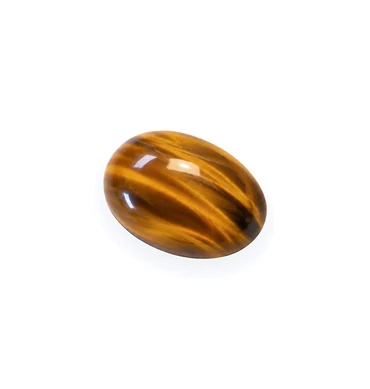
Tiger eye is a type of quartz. It started life as rock full of fine, parallel fibres of another mineral. Over a very long time quartz took the place of those fibres while keeping their shape, and iron oxides added the golden-brown colour. Because the fibres lie parallel, they bounce light back in one bright line. Cut the stone as a domed cabochon with the fibres running flat, and that line shows as a band across the top that rolls from side to side as you tilt it. The effect is called chatoyancy.
Three facts follow, and every useful check depends on them:
- the band has to move when the stone or the light moves;
- the fibres are natural, so they are a little wavy and uneven, never machine-perfect;
- the stone is quartz, with quartz's hardness and weight.
The copies you will come across
Fibre-optic glass
This is the one you are most likely to meet. Factories fuse thousands of thin glass fibres into a block, colour it and cut cabochons that show a strong, sharp band. It is sold in all sorts of colours as "cat's eye", and the golden-brown pieces get passed off as tiger eye. The band is usually brighter and more uniform than any natural stone manages, and that is your first clue.
Dyed quartzite or agate
Plain quartzite, agate or chalcedony dyed brown or gold copies the colour but not the light. These stones look flat. Either there is no rolling band at all, or there is a stripe that stays put when you tilt the stone.
Resin and plastic
Cheap beads and pendants are sometimes moulded resin with a printed or layered pattern. They feel light, warm up straight away in the hand and mark easily.
Real stones under the wrong name
Not every wrong label is a fake. Hawk's eye (blue-grey), red tiger eye and tiger iron are all genuine and all related, but they are different products at different prices. Tiger iron, banded with red jasper and grey hematite, has its own tiger iron buying guide, and you will find it in our iron tiger eye collection.
Checks you can do at home
All you need is daylight or a single bulb, a 10x loupe if you have one, and a minute or two. Use several checks together rather than relying on one.
1. Rock it under one light
Hold the stone under a single light and tilt it slowly back and forth. On real tiger eye the band slides across the surface and changes in brightness as it goes. If nothing moves, or a stripe sits stubbornly in one place, you are most likely looking at a dyed stone or a printed pattern.
2. Look at it from the side
If you only do one test, do this one. Put the loupe on the edge or the back of the cabochon. Natural tiger eye shows fine fibres that wave, bend and change thickness, with the colour shifting between golden and brown bands. Fibre-optic glass, seen end-on, shows a perfectly regular pattern, often a tiny honeycomb or grid of identical cells. Nature simply does not make anything that neat.
3. Study the colour
Real tiger eye has zones of honey, gold and brown that change across the stone, sometimes with darker streaks running through. A stone that is one completely flat colour, or a bright shade tiger eye never comes in naturally, should make you ask about dye.
4. Look inside with the loupe
Round gas bubbles or swirl marks mean glass or resin. Natural tiger eye has no bubbles.
5. Feel the temperature and weight
Quartz feels cool and warms up slowly in your hand. Resin feels warm almost at once and is noticeably light. Glass can feel much like quartz, so this check only weeds out the cheapest copies.
A test to leave alone
Do not scratch a stone you are thinking of buying, and do not let a seller scratch it on glass to impress you. It proves little, since quartz and some glass will both mark a window, and it can chip the edge of a perfectly good cabochon.
Tiger eye and lehsunia: the mix-up that costs the most
"Cat's eye" gets used loosely here, and people lose real money because of it. True cat's eye, the lehsunia of Vedic astrology, is chrysoberyl. It is much harder, feels heavier for its size, and is usually honey-yellow to greenish with a fine, sharp silvery line. It also costs far more than tiger eye. Because tiger eye shows a band too, it sometimes ends up sold as lehsunia, by mistake or on purpose.
Signs that a "lehsunia" is really tiger eye or quartz cat's eye:
- a wide, silky band instead of a thin, crisp line;
- brown or strongly golden banding visible through the body;
- a large stone that feels light for its size;
- a price well below what chrysoberyl normally fetches.
If your astrologer has asked for lehsunia, buy chrysoberyl, ideally with a report. Our cat's eye collection and the lab-certified cat's eye page are the places to start. If you just love the look of a rolling band and want something affordable, tiger eye is a good stone in its own right, bought under its own name.
Beads, bracelets and tasbih
Strung beads are where copies turn up most, because buyers look at the strand as a whole and rarely check bead by bead. Glass and resin beads give themselves away by being too uniform: same shade, same band, same size, every time. Natural tiger eye beads differ from one to the next, and some show a weaker band than others because the fibres sit at a different angle in each. Check the drill holes as well. A painted or coated bead often shows a paler core or chipped colour around the hole. For a stone tasbih you will use every day, our tasbih page lists the materials we carry.
When a laboratory is worth it
For an everyday tiger eye a lab report rarely pays for itself. It does make sense when:
- a stone is being sold to you as chrysoberyl cat's eye and you want to be sure it is not quartz;
- you want to know whether an unusual colour is natural, heated or dyed;
- a large or carved piece is priced well above ordinary tiger eye.
A gem lab can measure refractive index and specific gravity, which separate quartz from chrysoberyl and from glass straight away, and can check for dye under magnification. You are welcome to have any stone you buy from us tested independently; our authenticity page explains how we describe our stones and what to do if a result does not match.
Treatments: what counts as normal
A treatment is not a fraud as long as it is disclosed. With tiger eye you will run into:
- Heating: gentle heat turns golden tiger eye red or reddish-brown. Most "red tiger eye" and "bull's eye" is made this way. It is stable and very common.
- Dyeing: pink, green, blue and purple tiger eye are dyed. The colour can collect in cracks or fade with time.
- Bleaching: acid can lighten the colour to a pale honey.
- Stabilising: cracked rough is sometimes soaked in resin before it is cut.
Ask the seller which of these applies and have it written on the invoice. We state any known treatment on every listing.
Buying tiger eye without getting caught out
- Ask for a photo or video of the exact stone. A short clip of it being tilted shows the band far better than any still picture.
- Buy it under its own name. Tiger eye, chashm-e-babri, hawk's eye or tiger iron, never lehsunia.
- Check the cut. The band should run across the centre and reach both edges. A crooked or weak band means the fibres were not lined up properly when it was cut.
- Ask about treatment, particularly on red or unusual colours.
- Pay only after you have checked. With Cash on Delivery you open the parcel, tilt the stone under a light and look at its side before any money changes hands.
Every stone in our tiger eye collection is photographed on its own. Two examples: this 11.60 carat chashm-e-babri, a comfortable ring size, and this 28.65 carat tiger eye, big enough for a bold pendant. Our upcoming guides to tiger eye price and how to wear tiger eye deal with value and setting in more depth.
Caring for it once you know it is real
At around 7 on the Mohs scale, tiger eye is tough enough for a ring you wear every day. Wash it in lukewarm water with mild soap and a soft brush, keep it away from harsh chemicals that can damage dyed or bleached stones, and store it apart from harder gems. A bezel setting protects the rim of the cabochon from chips.
We deliver across Pakistan by insured, tracked courier. Orders are confirmed by phone or WhatsApp and dispatched within one working day. In Karachi, from Clifton and DHA to Gulistan-e-Jauhar, a parcel usually arrives in 1 to 2 working days; Lahore, Islamabad, Rawalpindi and the other big cities take 2 to 4, and smaller towns up to about 7. Delivery is a flat Rs. 500 per order, and unused stones can be returned within 7 days. If you have a question about a particular stone, message us on WhatsApp.
Shop the stones: tiger eye.
References