In this article
- What might be sold to you as amethyst
- Glass: the easiest one to catch
- Synthetic amethyst: the real headache
- Dyed and coated quartz
- Other purple stones, and mix-ups both ways
- Five checks to do at home
- Treatments: heated amethyst and colour changes
- Rings and tasbih: extra things to check
- What only a lab can tell you
- Buying amethyst safely
- خلاصہ

Written by Sameer
Reviewed on
In short: glass pretending to be amethyst can usually be caught at home with a loupe, a sheet of white paper and a little patience. Synthetic amethyst can't. Lab-grown amethyst is exactly the same mineral as natural amethyst, just made in a factory, and there is a great deal of it in Pakistani markets. Only a gem lab can reliably tell the two apart, so for any stone priced as natural, ask for a report or buy where you can return it after having it tested.
Amethyst, our jamunia (some say katela), is purple quartz with a hardness of 7. It is one of the most affordable natural gems, and that is exactly why fakes are everywhere: people expect a low price and don't ask questions. Below we go through each type of imitation, the checks you can do yourself, the treatments worth knowing about, and how to buy safely. For care once you own a stone, see keeping amethyst purple.
What might be sold to you as amethyst
| Material | What it actually is | Can you catch it at home? |
|---|---|---|
| Purple glass | Moulded or cut coloured glass | Often, with a loupe and a few simple checks |
| Synthetic amethyst | Lab-grown quartz with the same chemistry and hardness | Rarely; you need a lab |
| Dyed quartz | Pale or cracked quartz soaked in purple dye | Usually; the dye gathers in cracks |
| Coated quartz | Colourless quartz with a purple film | Sometimes; look at worn edges |
| Other purple stones | Purple sapphire, spinel, iolite, fluorite | Partly; some need instruments |
| Heated amethyst | Natural amethyst heated to lighten or shift its colour | No, and it isn't a fake; it is a treatment |
Glass: the easiest one to catch
Purple glass turns up loose, in cheap rings, and as "laser cut" stones on bazaar stalls. Glass has no crystal structure, so it behaves differently from quartz in a few telling ways.
- Bubbles. Under a 10x loupe, glass often shows round or stretched gas bubbles. Natural amethyst never has round bubbles.
- Swirls. Glass can show curved flow lines, like syrup being stirred into water.
- Moulded edges. Cheap glass is pressed in a mould, so the facet edges look soft and rounded and the faces may be slightly dished, rather than the crisp, flat facets of a cut stone.
- Warmth. Touch the stone to your lip or the inside of your wrist. Quartz feels cool and stays cool a bit longer; glass warms up fast. It works best comparing two stones side by side.
- Flat, even colour. Glass is usually the same purple all the way through, with no zoning at all.
- Scuffed facets. Glass is softer than quartz, so a worn glass stone collects nicks and scratches along the facet edges sooner.
Please don't scratch-test. It can damage a real stone, and hardly anyone carries the right reference minerals anyway.
Synthetic amethyst: the real headache
Synthetic amethyst is grown in a pressure vessel from the same ingredients as natural quartz. Same hardness, same refractive index, same weight. At bazaar prices it is extremely common, and the seller doesn't always know what they have, because it often arrived mixed into a parcel.
Signs that lean towards synthetic, though none of them proves it:
- Perfect clarity at a low price, especially in bigger stones.
- Perfectly even colour with no zoning from any angle.
- Lots of identical stones, same size, colour and cut, sold in strings or lots.
- Breadcrumb-like specks or a flat "seed" plane inside, which some lab-grown crystals have.
Natural amethyst almost always shows some zoning: straight or angular bands, or patches where the purple is stronger on one side. A lab confirms origin using things like twinning patterns under polarised light and infrared spectroscopy, none of which you can do at home. For more on how labs separate natural from lab-grown stones, read natural vs synthetic gemstones.
Dyed and coated quartz
Pale or cloudy quartz is sometimes heated to crackle it and then soaked in purple dye, which is common with beads and tumbled stones. Under a loupe, look for colour packed along the cracks, like ink running into lines, with paler areas between. A cotton bud dipped in nail polish remover (acetone) and rubbed on a hidden spot will sometimes lift dye. Only try this on a stone you own, never on a seller's stock without asking.
Coated quartz has a thin purple film on the back or over the whole stone. Check the girdle and the facet edges, where a coating wears through first. Coatings can also show a faint rainbow sheen that natural amethyst doesn't have.
Other purple stones, and mix-ups both ways
Several purple gems look alike, and some cost far more than amethyst, so the confusion can go in either direction.
- Purple sapphire is much harder and much denser; at the same size it feels clearly heavier in the hand. Compare with our purple sapphire collection.
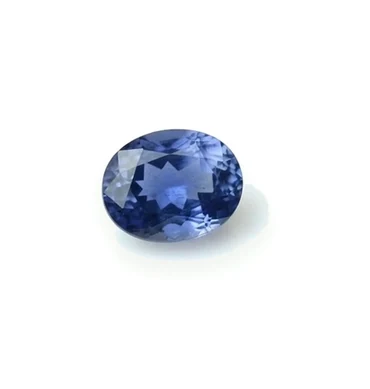
- Iolite changes colour strongly with direction, violet-blue one way and almost colourless or grey the other. Amethyst shifts only slightly.
- Purple fluorite is soft, often shows straight cleavage cracks, and scratches easily.
- Purple spinel looks the same colour from every angle and is heavier.
A refractometer and a hydrostatic balance sort all of these out quickly, which is why basic identification is the cheapest kind of lab test.
Five checks to do at home
- White paper. Lay the stone face-down on white paper in daylight from a window. Looking through the sides, natural amethyst usually shows uneven zones of purple. Perfectly even colour is a reason to look harder.
- Loupe. Hunt for round bubbles and swirls (glass), and for natural features such as feathers, tiny crystals or "tiger stripe" colour bands (natural quartz).
- Facet edges. Run the loupe along them. Crisp, sharp edges suit quartz; rounded or chipped ones suggest glass.
- Temperature. Compare with a quartz you know is genuine. Glass warms faster.
- Price. Ask yourself why a big, flawless, deep purple stone is so cheap. The usual answer is "synthetic". Compare with the ranges in our gemstone price guide.
These checks are good at catching glass and dye. They don't prove natural origin. Our broader guide, real or fake gemstones, has more methods.
Treatments: heated amethyst and colour changes
Heat is the main treatment used on amethyst. A gentle heat can lighten a dark, inky stone or clear a brownish tint. Stronger heat turns it yellow or orange, and much of the citrine for sale began life as amethyst; see citrine, heated and natural. Some heated material goes green and is sold as "green amethyst" or prasiolite.
Heating is stable and accepted as long as it is disclosed. It is not the same thing as a fake; what matters is that you are told. Some amethyst is also irradiated to deepen the colour, and that should be disclosed too. We state known treatment on every listing.
A related point: natural amethyst can fade in strong sunlight over a long time. A stone that went pale sitting in a sunny shop window is still natural. It was just stored badly.
Rings and tasbih: extra things to check
Set stones and beads hide some of the clues. In a ring the back is covered, so look for zoning through the top, and ask yourself why a cheap silver ring holds such a large, clean stone. On a tasbih or bracelet, look at the drill holes under a loupe: dyed beads often show concentrated colour or a white core around the hole, and glass beads can show small shell-shaped chips, like broken bottle glass, at the rim. Natural amethyst beads usually vary a little in shade from one to the next. Our gemstone tasbih page explains how bead strings are judged.
What only a lab can tell you
- Whether the stone is natural or lab-grown.
- Whether the colour comes from irradiation.
- Whether a "purple sapphire" or "spinel" is really amethyst, or the other way round, if you can't weigh it accurately.
Testing costs money, so for an inexpensive amethyst it may not be worth it. For a large stone, an astrological purchase, or a gift where natural origin matters, it is. See lab-certified amethyst and how to read a gemstone lab certificate.
Buying amethyst safely
- Ask outright: "Is this natural or lab-grown? Has it been heated or irradiated?" Note the answer down, or get it in a WhatsApp message.
- Get the weight in carats, and if the seller quotes ratti, convert it with the carat to ratti converter. The gem ratti is 0.91 carat.
- Ask for photos and video in daylight, not under the purple or blue shop lights that make any stone look richer.
- Prefer a return window long enough to get the stone checked.
- Be wary of "100% original" claims with nothing to back them up.
Every stone in our amethyst collection is natural and photographed individually, such as the 10.35-carat jamunia or the 11.30-carat jamunia. "Laser cut" in our titles describes the faceting style, not the material. We send from Karachi with Cash on Delivery: Karachi usually in 1 to 2 working days, the other big cities in 2 to 4, and anywhere else in Pakistan within about a week. Check the stone before paying the rider, and return it within 7 days if you aren't happy. Questions are always welcome on WhatsApp.
Shop the stones: amethyst.
References