In this article

Written by Sameer
Reviewed on
Amber is not a mineral. It is tree resin that has slowly hardened over millions of years, and that long history is exactly what its imitations are missing. In Pakistan we sell amber as kehruba, and in our experience the pieces that fool people are hardly ever glass. They are copal (much younger resin), pressed amber, or moulded plastic. Each of them fails at least one of the easy checks below.
Why amber is so easy to copy
Amber is light, warm to the touch, soft, and usually somewhere between honey and cognac in colour. At a quick glance plastic can match every one of those. Copal is even closer, because chemically it is the same kind of resin, just a few thousand years old instead of millions. A seller does not even need to lie outright. Simply calling copal "amber" does the job. That is why a few hands-on checks matter more with kehruba than with nearly any other stone we sell.
Five checks, gentlest first
1. How it feels in your hand
Amber is surprisingly light for its size, and it never feels cold the way glass or stone does. If a piece is heavy and chilly, it is almost certainly glass. This will not separate amber from plastic or copal, but it gets rid of the crude fakes in seconds.
2. Float it in salt water
Stir plenty of salt into a glass of water, roughly until no more will dissolve easily, then drop in a loose, unset piece. Real amber and copal both float in strong brine. Glass always sinks, and so do most plastics. Rinse the piece in plain water afterwards. Do not try this with set amber, as the metal will drag it down and tell you nothing.
3. Shine a long-wave UV torch on it
Under long-wave UV, natural amber usually shows a milky blue, blue-white or soft green glow on its surface. Many plastics stay dull, or glow in a flat, even, artificial-looking way. Pressed amber can glow in patches with a grainy look, where small bits of amber were fused together.
4. Look at what is inside
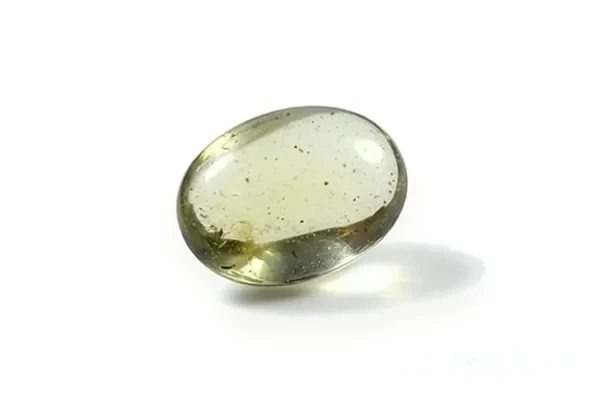
Genuine amber often holds tiny bubbles, specks of plant material, or swirl lines left by the resin as it flowed. Be suspicious of a perfect insect sitting right in the middle of a flawless, cheap piece, and of round bubbles that all look exactly alike.
5. The solvent check that catches copal
Put a drop of acetone on a hidden spot and amber stays as it is, while copal turns sticky within seconds. Since this can mark the surface, let the seller or a lab do it rather than testing a piece you have not paid for yet. For the same reason we do not recommend the hot-needle test.
Looking after amber once it is yours
Kehruba is only 2 to 2.5 on the Mohs scale, so it scratches easily. It is happier as a pendant, beads or earrings than in a ring that bumps a desk all day. Keep it away from perfume, hair spray and alcohol-based sanitiser, wipe it with a soft damp cloth, and never put it in an ultrasonic cleaner.
Tradition, and what we can promise
In folk tradition across Asia and Europe, amber has long been carried for warmth and vitality. These are beliefs, not guaranteed effects. If an astrologer has suggested amber for you, agree the weight and metal with them first. Our rashi guide lists the common pairings.
Buying kehruba from Authentic Gems
We check every piece ourselves and photograph each one on its own, so the amber in the listing is the amber you receive. You pay Cash on Delivery only after opening the parcel and looking at it, and if you want extra certainty, our authenticity page explains how independent testing works. Browse the amber collection, or have a look at cat's eye and kunzite. Urdu names for every stone are on our names page. We deliver from Karachi to Lahore and every other city in Pakistan.
References