In this article

Written by Sameer
Reviewed on
A real cat's eye has a soft, living line of light that slides across the dome and shifts as you move a torch over it. Fibre-optic glass gives you a line that is too sharp, too even and visible from too many angles, and from the side it often shows a honeycomb of tiny tubes. That one check catches most of the fakes sold as lehsunia in Pakistan. The rest of this page covers the other imitations, what you can check at home, and what only a lab can answer.
Our lehsunia grading guide explains how a genuine stone is valued. Here the question is more basic: is it genuine at all, and is it the mineral the seller says it is?
"Real" cat's eye can mean several things
"Cat's eye" is the name of an effect, not of a single mineral. The effect, called chatoyancy, comes from fine parallel fibres or hollow tubes inside a stone, which bounce light into one bright band when the stone is cut as a cabochon. Plenty of minerals can do this, so a stone can be a perfectly natural cat's eye and still not be the lehsunia your astrologer had in mind.
| Stone | Natural? | Notes |
|---|---|---|
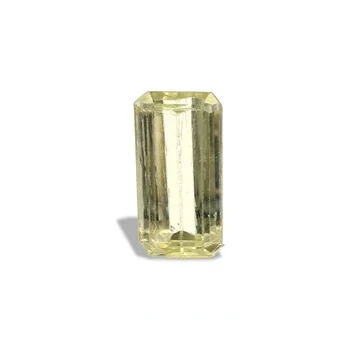
| Chrysoberyl cat's eye | Yes | The classic lehsunia of Vedic tradition; hard (8.5) and heavy; honey to greenish shades |
| Quartz cat's eye | Yes | Softer (7), lighter, with a fainter eye; far cheaper |
| Tourmaline, apatite, scapolite and others | Yes | Natural cat's eyes of other species; each should be named as such |
| Fibre-optic glass | No | Man-made; the most common imitation |
| Ulexite ("TV stone") | A natural mineral, but the wrong stone | Very soft; sometimes dyed and sold as lehsunia |
| Dyed or coated stones | Treated | A natural base with colour added |
So "is it real?" is really two questions: is it natural, and which mineral is it? A natural quartz cat's eye sold at a fair quartz price is an honest stone. The very same stone sold as chrysoberyl is not.
About dark and "black" cat's eye
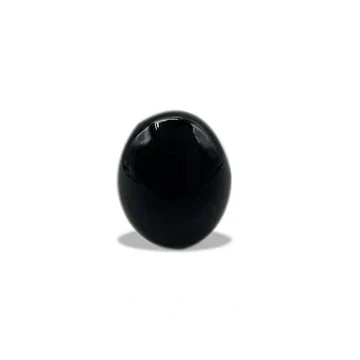
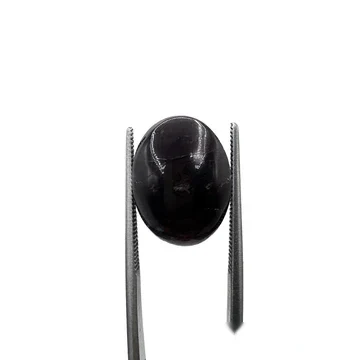
Stones sold as black cat's eye can be any of several minerals, including dark chrysoberyl, tourmaline and other fibrous species. Each is a natural cat's eye, but they aren't interchangeable in price or in tradition. Our 10.00 carat black cat's eye and 12.10 carat black cat's eye are examples of this darker material. Whatever you buy, ask the seller to write the mineral on the invoice.
The fakes you're most likely to run into
Fibre-optic glass
Sold under names like "cat's eye glass", this is bundles of glass fibres fused together and coloured. It comes in honey, green, brown and lots of bright colours that natural lehsunia never has. The eye is very sharp and very bright, and often looks painted on. From the side or the base you can see a fine hexagonal pattern like a honeycomb. It costs far less to make than any natural cat's eye, so the price is often the first clue.
Ulexite
Ulexite is a soft borate mineral whose fibres carry an image from one face to the other, which is why it is called "TV stone". Cut as a cabochon and dyed, it can pass for lehsunia in a photo. In the hand it is light, it scratches easily, and it loses its polish quickly.
Dyed quartz and tiger's eye
Quartz cat's eye is sometimes dyed honey or green to look like chrysoberyl. Plain tiger's eye, which has a moving band, is now and then sold as lehsunia too. Tiger's eye shows a broad, rolling golden sheen across stripes, not a single thin line.
Lab-grown chrysoberyl
Synthetic chrysoberyl cat's eye does exist, but it is rare in Pakistani bazaars. It has the same hardness and weight as natural stone, and only a gem lab can separate the two with confidence.
Checks you can do at home
None of these proves anything by itself, but together they tell you whether a stone is worth a lab fee. Don't scratch-test a stone you don't own; it damages good stones and proves very little.
- The torch test. In a dim room, hold a phone torch above the stone and move it slowly from side to side. On a natural cat's eye the line follows the light smoothly and stays thin. On fibre-optic glass the line is often very wide or far too bright, and sometimes several faint lines show up.
- Milk and honey. Shine the torch from one side at a fine chrysoberyl. The half nearest the light turns milky while the far half stays honey-coloured, and when you turn the stone they swap. Quartz and glass rarely show this so clearly.
- The side view. Look at the edge and base through a 10x loupe. A honeycomb or mesh of tiny cells means fibre-optic glass. Natural stones show fine parallel silk, not a grid.
- The colour. Natural lehsunia comes in honey, yellowish, greenish, brownish and dark shades. Bright pink, blue, purple or neon orange stones with a strong eye are nearly always glass.
- The weight in your palm. Chrysoberyl is heavy, with a specific gravity of about 3.7; quartz is about 2.65. Two stones of the same outline and dome, one chrysoberyl and one quartz, feel clearly different in the hand.
- The surface. Chrysoberyl keeps a crisp, glassy polish for years. Soft fakes soon show rounded edges and fine scratches.
- Where the eye sits. A natural eye can sit a little off centre or curve slightly. A perfectly centred, ruler-straight eye on a cheap stone should make you wary.
What only a lab can settle
Some questions need instruments. A gem lab measures refractive index (around 1.74 to 1.75 for chrysoberyl, around 1.54 for quartz), specific gravity, and the absorption spectrum, where chrysoberyl often shows a characteristic band in the blue. It can also identify synthetic chrysoberyl and some treatments.
A lab report is worth having when:
- the stone is sold as chrysoberyl at a chrysoberyl price;
- it is going into a gold ring on an astrologer's advice;
- the seller names an origin, such as Sri Lanka, that adds to the price.
You are welcome to have any stone you buy from us tested independently. Our guide to reading a lab certificate explains each line, and lab-certified cat's eye stones are listed on a page of their own.
Treatments worth knowing about
Natural cat's eye is often sold untreated, but not always. Some chrysoberyl is irradiated to warm its colour towards honey or to sharpen the milk-and-honey contrast. Quartz and other fibrous stones may be dyed, and surface coatings sometimes turn up on cheaper material. None of these turns a fake into a real stone, or a real one into a fake, but each changes the value and should be disclosed in writing. Ask: "Has this stone been heated, irradiated, dyed or coated?"
Buying lehsunia safely in Pakistan
Most bad buys happen when someone pays chrysoberyl money for glass or quartz on a seller's word. A few habits stop that happening.
- Ask for the mineral by name. "Lehsunia" on its own isn't enough. Ask whether it is chrysoberyl, quartz or something else.
- Ask for a video. Have the stone turned under a single light so you can watch the line move.
- Get the weight right. Ask for the cut weight in carats. If ratti is used, ask which: the standard gem ratti in Pakistan is 0.91 carat, the sunari ratti about 0.61 carat. Our carat to ratti converter helps.
- Get it in writing. The invoice should say natural, name the mineral and list any treatment.
- Check before you pay. With our Cash on Delivery you open the parcel and check the stone in front of the rider before paying, anywhere in Pakistan. Have a phone torch ready at the door.
- Remember the return window. You have 7 days to return an unused stone that isn't as described; see the returns policy.
We confirm each order by phone or WhatsApp and dispatch within 1 working day by insured, tracked courier. Karachi orders usually arrive in 1–2 working days, Lahore, Islamabad and other major cities in 2–4, and smaller towns within about 7.
Bazaar lines worth questioning
- "Ceylon lehsunia" is an origin claim. Ask how they know; only a lab can offer an opinion on origin.
- "Asli, guarantee wala" means little unless the guarantee names the mineral and says what happens if a test disagrees.
- "Same quality, half price" usually means a different mineral, often quartz or glass.
- "Test it with fire" and other folk tests can crack a good stone and prove nothing. Use light and a loupe instead.
A note on tradition
In Vedic astrology lehsunia is Ketu's gem, and it is often talked about together with gomed, the gem of Rahu. Many astrologers suggest a trial period before the stone is set. These are beliefs held by many families, not promised results, so settle the weight, metal and finger with your astrologer before you buy. Our page on the nine planetary stones gives the background, and the upcoming how to wear cat's eye post covers the customs.
In short
- Look for a thin, soft line that follows the light.
- Check the side for a honeycomb pattern.
- Be wary of bright, unnatural colours with a perfect eye.
- Ask which mineral it is, and get it written down.
- Use a lab for any stone sold as chrysoberyl at a serious price.
Browse our natural cat's eye stones, each photographed on its own, or read our broader guide on checking any gemstone before you buy. The upcoming cat's eye price guide explains what drives the cost.
Shop the stones: cat eye.
The beliefs mentioned here are traditions, shared for interest. They are not promised outcomes, religious rulings or medical advice.
References