In this article
- Where the name and the reputation come from
- Feroza in Islamic and Persian tradition
- Feroza in Vedic astrology
- Who traditionally wears feroza
- What turquoise does well
- Where feroza is weak
- The colour change families talk about
- Caring for a feroza you wear
- Choosing a feroza you will be happy with
- Buying from Authentic Gems
- خلاصہ

Written by Sameer
Reviewed on
Traditional belief vs gemmology: anything on this page about luck, protection, planets, healing or religious tradition describes traditional and cultural beliefs — not proven effects, religious rulings or medical advice. A stone's identity, hardness, treatment and origin are gemmology, which a lab can test; the references at the end of the page cover that side.
Ask ten families in Pakistan what feroza is good for and you will get ten versions of one answer: it keeps you safe, it brings success, and you should wear it before a journey. Those beliefs come from three old traditions that meet in this country, Persian, Islamic and Vedic, and they sit beside some very ordinary practical facts about turquoise as a material. We keep the two apart here. The first half sets out what each tradition says, as tradition and nothing more. The second half covers what the stone itself does well, where it is weak, and how to look after it so the sky blue you paid for stays that way.
If you want to check whether a stone is genuine, our guide to real and fake feroza covers that in detail, and judging feroza quality explains matrix, colour and stabilisation. This article sticks to the question people ask first: why wear it at all?
Where the name and the reputation come from
The word feroza is Persian and is usually connected with victory or good fortune. Turquoise has been mined near Nishapur in Iran for many centuries, and from there it travelled the trade routes into Central Asia, Afghanistan and the subcontinent. It was set into domes, horse harnesses, sword hilts and rings. By the time it reached the cities of the subcontinent it already had a name as a stone of protection and success, and that reputation has never left it.
Here you will hear it called feroza, firoza or just turquoise, and in the bazaar a clean, even blue is still sold as "Nishapuri" whether or not anyone can prove where it was mined. Our feroza in Muslim tradition page explains that label and what it does and does not tell you.
Feroza in Islamic and Persian tradition
Alongside aqeeq and dur-e-najaf, feroza is one of the stones most often named in Muslim devotional custom, particularly among Shia families. Sayings attributed to the Imams praise wearing it, and many households keep a feroza ring for a son leaving for university or a father setting off on a long trip. Scholars differ on how strong these reports are, so if the religious side matters to you, ask a scholar you trust. We give no ruling.
Common family customs include:
- Travel: many families believe a feroza worn on a journey helps the traveller come home safely, which is why it is such a popular gift before Hajj, Umrah, Ziyarat or a long road trip.
- Protection from nazar: the blue is traditionally linked with turning away the evil eye, a belief shared across Iran, Turkey and the subcontinent.
- Success and honour: in keeping with the meaning of the name, it is often given for a new job, a graduation or a nikah.
Our wider Islamic gemstones guide covers the other stones in the same tradition.
Feroza in Vedic astrology
Vedic astrology usually links feroza with Jupiter (Guru), and some astrologers suggest it as a cheaper alternative where pukhraj would otherwise be advised. Others connect it with Venus or with Rahu. Disagreement like this is normal in astrology, and it is one reason we suggest you settle the stone, weight and finger with your own astrologer before a ring is made, instead of going by a general list. On Western birthstone lists turquoise is one of the December birthstones.
By tradition feroza is set in silver more often than gold, and the ring or little finger of the right hand is the usual choice. When the Jupiter link is followed, many astrologers name Thursday morning for the first wearing. These are customs, not rules, and none of them changes what the stone is.
Who traditionally wears feroza
Because the beliefs around it are broad and gentle, feroza is one of the few stones families here give freely without checking a horoscope first. You will see it on:
- men who want a simple, recognisable stone in a feroza ring, usually in silver;
- travellers, drivers and anyone whose work keeps them on the road;
- students before exams and young people starting their first job;
- women who love the colour in a pendant or earrings, where the beliefs are a pleasant extra rather than the reason to buy;
- people who already wear an aqeeq and want a second stone from the same tradition.
If you are undecided, our which gemstone to wear guide and the protection stones page set out the usual choices side by side.
What turquoise does well
Leave the beliefs aside and turquoise still has real practical strengths, which is part of why it has stayed popular so long.
Colour you can see across a room
Feroza is opaque, so its colour does not depend on the cut, the light or what is behind it in the setting. A good blue looks the same in a dim room as in sunshine. That makes it easy to buy from a photo and easy to match with clothes, which is not true of most transparent gems.
Light for its size
Turquoise is fairly light, so even a large cabochon sits comfortably in a ring or pendant. Men who want a bold stone without a heavy ring often pick it for exactly that reason.
Easy to set in silver
Silver is the traditional metal and flatters the colour. A smooth cabochon with a flat back fits neatly into a simple bezel. Our chandi ring with stone page explains what to ask a silversmith.
Where feroza is weak
The honest part of any benefits list is what the stone cannot do. Feroza is about 5 to 6 on the Mohs scale, softer than quartz, and most of it is porous. In practice:
- it scratches more easily than sapphire, topaz or agate;
- it soaks up oil, sweat, soap and perfume, and over time a soft stone can drift from blue towards green;
- it does not like heat or strong chemicals, which can dull the polish or change the colour;
- a hard knock on a thin edge can chip it.
Denser stones stand up to all of this better, which is why they cost more. Stabilised turquoise, soaked in resin to harden it and fix the colour, is still turquoise and a sensible pick for a ring worn every day. What matters is that the seller tells you which one you are buying; we state known treatments on every listing.
The colour change families talk about
You may have heard that a feroza turns green or pale when it has "taken" something bad away from the wearer. That is a popular belief. The physical explanation is simpler: porous turquoise absorbs skin oils, soap and cosmetics and slowly changes colour. Softer, lower-grade stones change faster, while dense or stabilised stones barely change. If you want your stone to stay blue, the care steps below matter more than anything else.
Caring for a feroza you wear
- Put it on last. Let cream, attar, perfume and hair oil dry before the ring goes on.
- Take it off for wudu if you can. Soap and water several times a day are hard on a porous stone. Many wearers keep a small dish for the ring where they make wudu.
- Clean it with a dry or barely damp cloth. No soaking, no detergent, no ultrasonic or steam cleaning.
- Keep it away from heat. Never leave it on a car dashboard in a Karachi summer, or near the stove.
- Store it on its own. A soft pouch keeps harder stones from scratching it.
- Get the setting checked once a year. A loose bezel lets dirt collect under the stone. Our stone setting service page explains what a check involves.
Choosing a feroza you will be happy with
Even if the beliefs are your reason for buying, the stone has to be genuine and reasonably dense, or it will not last long enough to wear. A few practical pointers:
- Go for an even, saturated blue. Pale, chalky stones are usually the softest.
- Decide whether you want a clean stone or one with matrix (brown or black veins). Traditional buyers prefer clean stones for rings, while shajri feroza, with its branching pattern, has a following of its own.
- Ask whether it is natural, stabilised or dyed, and get the answer in writing.
- For a larger or costlier stone, ask about independent lab testing. Our lab-certified feroza page explains what a report covers.
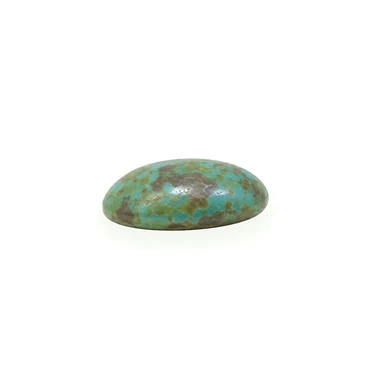
Every stone we hold is in the feroza collection, each photographed on its own. Two examples: this 12.60 carat turquoise suits a man's ring, and this 9.60 carat feroza sits nicely in a smaller ring or pendant. For what drives the cost, see feroza price in Pakistan, and if you like the blue but want something harder, lapis lazuli (lajward) is a traditional neighbour.
Buying from Authentic Gems
We deliver across Pakistan with Cash on Delivery, so you open the parcel and look at the stone before paying the rider. Orders are confirmed by phone or WhatsApp and dispatched within 1 working day by insured, tracked courier. Within Karachi, from DHA and Clifton to North Nazimabad and Gulistan-e-Jauhar, parcels usually arrive in 1 to 2 working days; Lahore, Islamabad, Rawalpindi and other major cities usually take 2 to 4, and smaller towns up to about 7. Delivery is a flat Rs. 500 and you have seven days to return a stone. If you want help choosing a size for a ring, or want to know whether a particular stone is stabilised, message us on WhatsApp and we will answer plainly.
Shop the stones: feroza.
The beliefs described here are traditions, shared for interest. They are not guaranteed outcomes, religious rulings or medical advice.
References